
1. The Nerve Net
While humans have a Central Nervous System (CNS) where the brain acts as a central computer , jellyfish use a Nerve Net. This is a decentralized mesh of neurons spread throughout their entire body. Instead of signals traveling to a central hub for processing, the jellyfish's skin and tentacles "process" information locally. If a tentacle touches a shrimp, it reacts instantly without waiting for a "command" from a brain. This full-body awareness allows them to respond to threats or food from any direction simultaneously. Some species even have two nets: a "large" one for swimming and a "small" one for feeding and curling.
2. Breathing Through Their Skin
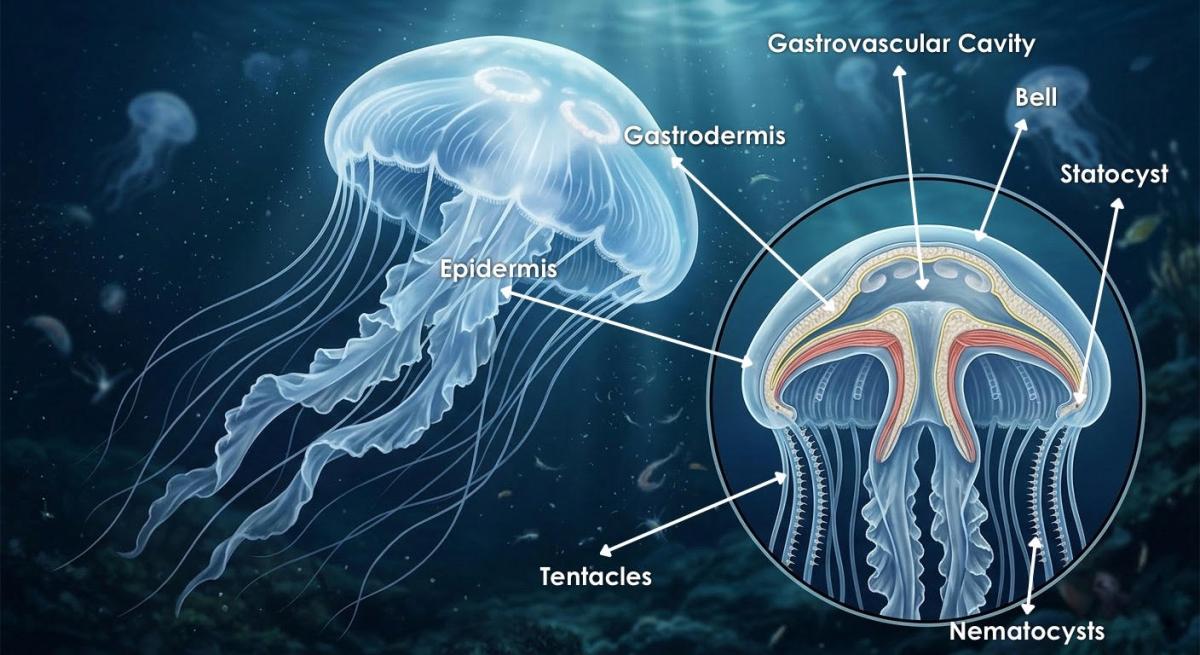
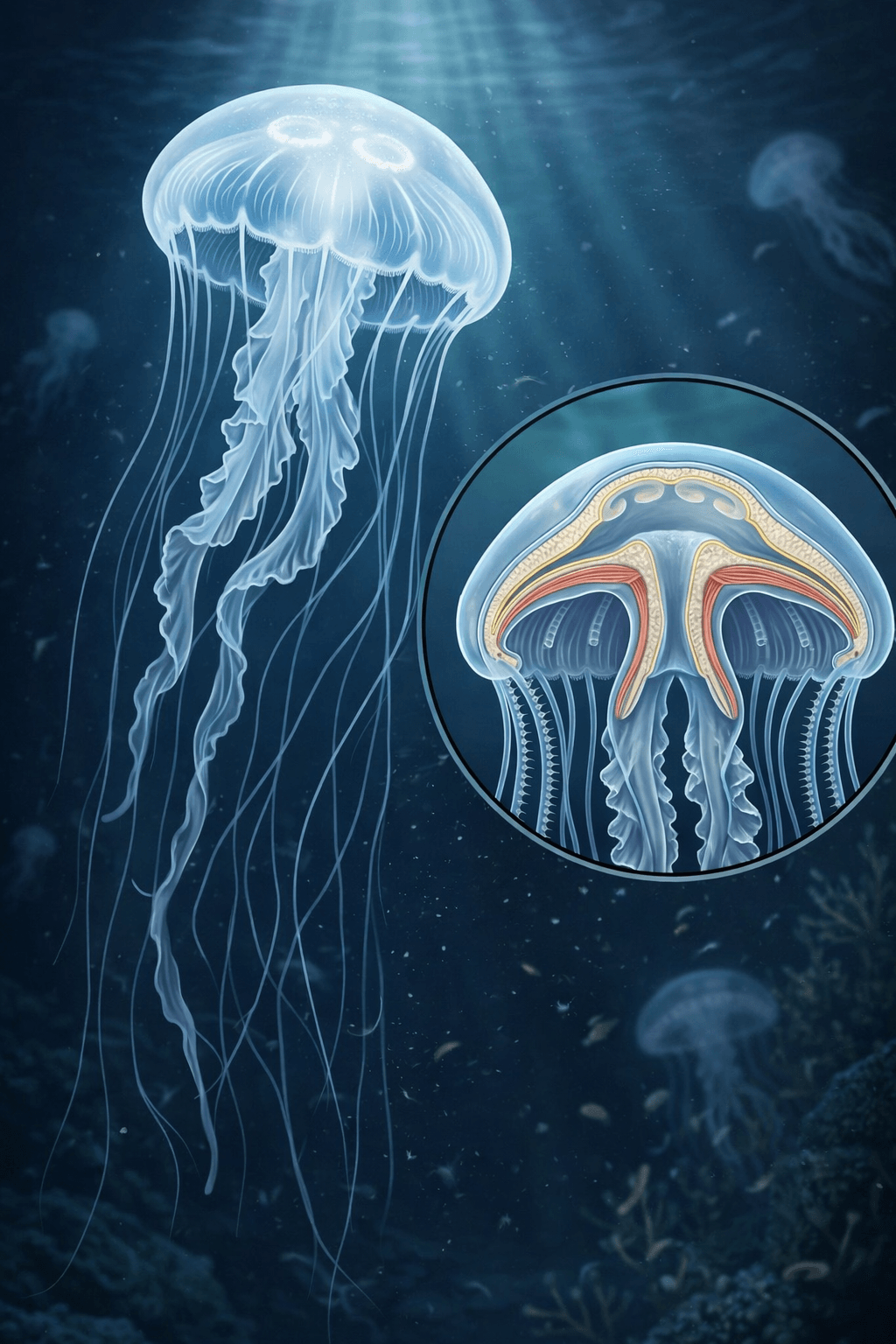
Without lungs or gills, jellyfish use direct diffusion. Because their body wall is extremely thin, consisting of only an outer epidermis and an inner gastrodermis oxygen molecules pass directly from the water into their cells. While humans have thick, waterproof skin and separate internal organs, a jellyfish is two-layered balloon where the outer "skin" (epidermis) acts as its lungs and the inner "lining" (gastrodermis) serves as its entire digestive system. They don't need blood because every cell is close enough to the outside world to "breathe" on its own.
3. The All-in-One Engine
Jellyfish don't have a multi-stage digestive tract. They have a Gastrovascular Cavity, a central space that serves as both the stomach and the circulatory system. They have a single opening which serves for both consuming and defecation. The digesting process is simple food is pulled into the bell, digested by enzymes, and nutrients are dispersed throughout the body via simple canals. Once the meal is finished, waste is expelled back out through the same opening.
4. High-Speed Weapon
Even without a brain to aim, jellyfish are lethal hunters thanks to nematocysts. These are stinging organelles that act like microscopic pressurized harpoons. When triggered, a nematocyst discharges in roughly 700 nanoseconds, making it one of the fastest processes in the animal kingdom.
5. Keeping Upright
How does a brainless creature know which way is up? Jellyfish use statocysts which is a small, weight-sensing organs located in structures called rhopalia around the edge of the bell. Each contains a tiny "stone" (statolith) that rolls onto sensory hairs as the jellyfish tilts, telling the nerve net how to adjust its swimming pulse to stay balanced.